
This article includes documentation of the so-called “Star Eater” issue with certain Sony cameras and long exposures of the night sky.
Update October, 2020:
According to multiple sources, including this video from Alan Stankevitz, the Sony a7SIII exhibits noticeable star eating noise reduction in its video mode at ISOs of 102400 and higher.
Update December, 2018:
With the discovery of a workaround, and improvement in the noise reduction algorithm in the Sony Mark III Alpha cameras (a7III and a7RIII), I have updated the title of this post and I have appended the content of my workaround post and elements of my a7III review to show what users can expect from these cameras. I still recommend Sony cameras for astrophotography, especially the new a7III and I still use the original a7S as my primary astrophotography camera. Those interested or concerned about the issue can read about how to avoid it here.
Documentation of the Problem
In 2016, Sony purportedly made firmware changes to their two flagship a7 series cameras (the a7RII and a7SII). The update (believed to be 3.30 on the a7RII and 2.10 on the a7SII) was supposed to include improvements for radio controlled lighting and overall camera stability and temperature control. But hidden in these improvements is a change that affects the image quality when shooting long exposures, particularly astrophotos. The problem has been dubbed “Star Eater” by others in the astro community. The issue also affected, from day one, the original line of a7 cameras when used in Bulb mode and the problem persists through out Sony’s latest line of cameras including the a9 and a7RIII.
The “Star Eater” problem is a form of software spatial filtering designed to reduce noise in photos, particularly hot pixels. Unfortunately, the rather rudimentary filtering algorithm that Sony is using easily mistakes sharp pinpoint stars for noise, nearly deleting them from the image or greatly reducing their brightness. The result is an astrophoto with less stars and the appearance of diminished resolution. Sony a7RII, a7SII and a7RIII cameras exhibit this problem for all exposure times longer than 3.2″. Furthermore, the “Star Eater” issue affects RAW images (whether uncompressed or not) and cannot be disabled by any means. There are no user selectable settings that will prevent these cameras from eating stars.
I have confirmed the issue myself and it has been discussed and analyzed many times on other places around the online photography community, particularly on the DPReview forums, Cloudy Nights, Jim Kasson’s Last Word, and more recently on Sony Alpha Rumors.
Bad spatial filtering isn’t new to Sony’s Alpha cameras. Even with the older firmware, all recent Sony alpha mirrorless cameras including the a6000, a6300, a6500, a7S, a7R, a7, a7II, a7SII and a7RII exhibit, in different ways, the “Star Eater” issue when using the Bulb exposure mode (my examples above are from the a7S in Bulb Mode). Untracked landscape astrophotography rarely requires exposures longer than 30″ so I found that the issue rarely affected my photography. (Most of my exposures are made between 5 and 20 seconds.)
The Workaround
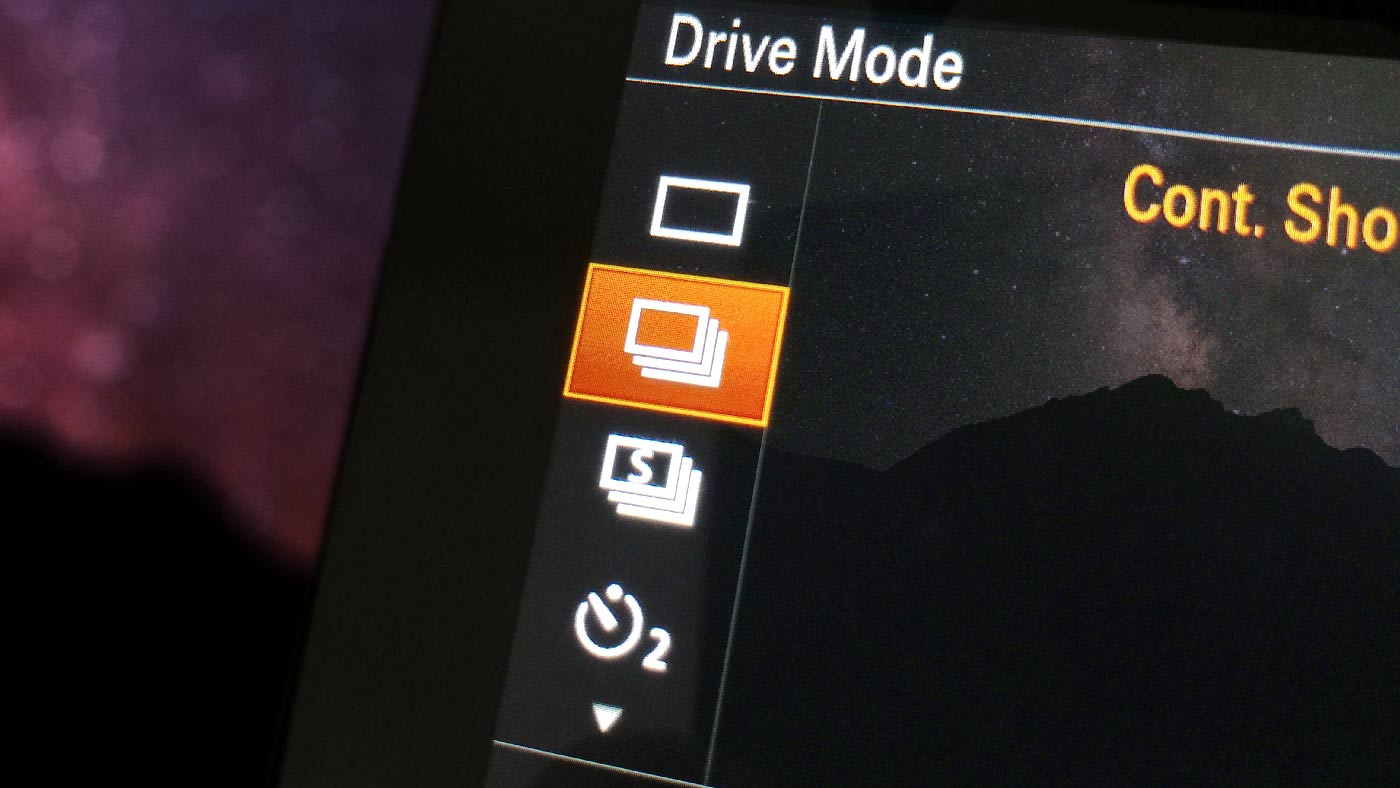
In a December 2017 post, Jim Kasson talked about a potential workaround on the a7RII. The fix is certainly counter-intuitive: enabling continuous drive mode while shooting long exposures. In his analysis, Jim shows that by enabling the continuous drive mode, the a7RII no longer exhibits the same behavior of the star-eating algorithm. Jim’s original analysis was only of the a7RII so I was curious to see if the same workaround would work on the a7SII. I had a friend supply some sample dark-frames from his a7SII and I took a close look at the files. Sure enough, enabling continuous mode seemed to prevent the star eater problem from occurring. I sent the frames to Jim for his final analysis of the a7SII star eater workaround which he has published here.
- So the good news: a7RII and a7SII users can circumvent the Sony star eater issue by shooting with continuous shutter mode enabled. Either regular “Continuous” or “Continuous Speed Priority” shutter modes will work.
- The bad news: by enabling continuous shutter mode, the color depth of the raw files is reduced to 12-bit. This means that the file is losing some dynamic range capability and may show some increase in noise. In all practicality, the results should be more desirable for astrophotography than the star-eaten files.
This workaround is a welcome find for owners of the a7RII and a7SII who enjoy shooting astrophotography but it’s still only a partial fix. Using the workaround, bit-depth is slightly reduced, limiting the dynamic range of the resulting photographs.
Should you care?
Maybe. I’ll admit that it is a problem that requires a fair bit of pixel peeping. Fellow landscape astrophotographer Michael Frye has made a great analysis of what you can expect from the a7RII. All told, some photographers might never even notice the issue. But as our community shifts more and more towards the enthusiast, to the photographer who really cares about the finest capability of their equipment, it’s an issue that I want to document.
Without using the workaround, the a7SII in particular is affected very greatly by this issue because of its lower resolution sensor. It was a camera that launched with praise about its low light capability and now I highly discourage you use an a7SII for astrophotography. Want to know how each camera is affected by the issue? Here’s a summary of the differences between each camera and recommendations on how to deal with it:
- Sony a7
- Camera timed exposures up to 30s unaffected.
- Bulb exposures affected.
- Recommendation: Don’t shoot astrophotography with Bulb exposures.
- Sony a7R
- Camera timed exposures up to 30s unaffected.
- Bulb exposures affected.
- Recommendation: Don’t shoot astrophotography with Bulb exposures.
- This camera not recommended for tracked astrophotography.
- Sony a7S
- Camera timed exposures up to 30s unaffected.
- Bulb exposures affected.
- Because of the lower resolution sensor (12MP), star eater issue for Bulb exposures is significantly more apparent.
- Recommendation: Don’t shoot astrophotography with Bulb exposures.
- This camera not recommended for tracked astrophotography.
- Sony a7II
- Camera timed exposures up to 30s unaffected.
- Bulb exposures affected.
- Recommendation: Don’t shoot astrophotography with Bulb exposures.
- This camera not recommended for tracked astrophotography.
- Sony a7SII
- Camera timed exposures longer than 3.2s affected.
- Bulb exposures affected.
- Because of the lower resolution sensor (12MP), star eater issue is significantly more apparent.
- Recommendation: Use continuous shutter mode. Don’t shoot astrophotography with Bulb exposures.
- Sony a7RII
- Camera timed exposures longer than 3.2s affected.
- Bulb exposures affected.
- Continuous Low and High modes are a potential workaround, but with a reduction to 12-bit color depth.
- Recommendation: Use continuous shutter mode. The issue is mostly hidden by this camera’s higher resolution sensor. Don’t shoot astrophotography with Bulb exposures.
- Sony a9
- All timed exposures affected.
- Bulb exposures affected.
- Recommendation: Don’t shoot astrophotography with Bulb exposures. The issue can be partially hidden by this camera’s higher resolution sensor. Use longer than recommended exposure times to increase star trailing to reduce the effects of star eater.
- Sony a7RIII
- Camera timed exposures longer than 3.2s affected.
- Shows improvement over a7RII.
- Recommendation: The issue is mostly hidden by this camera’s higher resolution sensor. Use of long enough exposure times to increase star trailing will reduce the effects of star eater.
- Sony a7III
- Camera timed exposures longer than 3.2s affected.
- Shows improvement over previous generation
- Recommendation: The issue is mostly hidden by this camera’s higher resolution sensor and improved algorithm. Use of long enough exposure times to increase star trailing will reduce the effects of star eater.
Improvements in the Sony a7III
The below section is an excerpt from my a7III review.
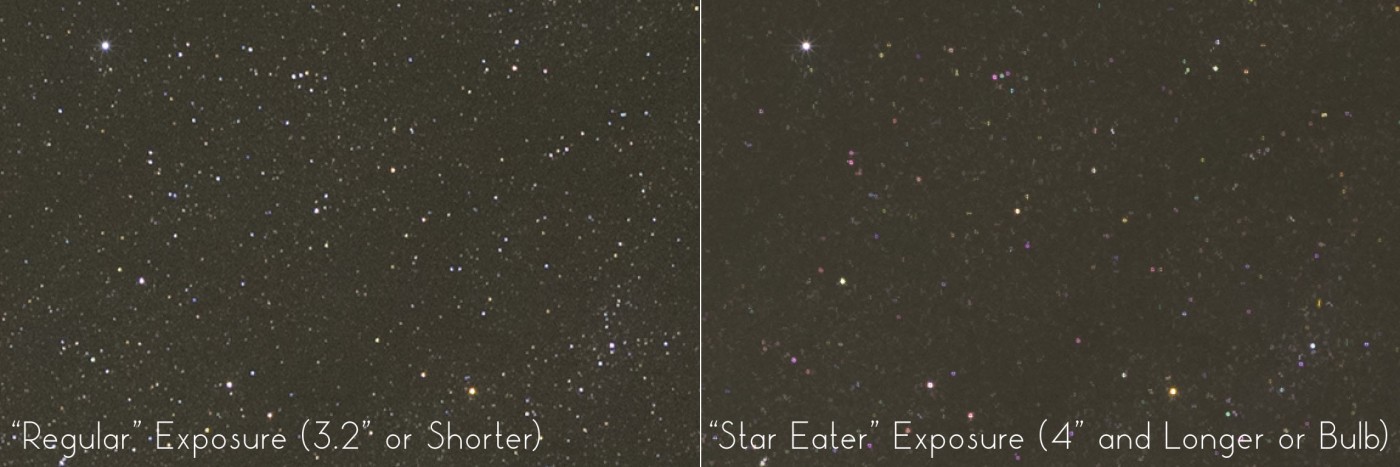
The a7III exhibits a similar, but different characteristic noise filtering as previous generations. The filtering reduces noise and diminishes the brightness of small dim stars in an image for exposures of 4 seconds or longer. An easy way to see the effects of star-eater on the a7III is to simply compare a 3.2s exposure (left) with a 4s exposure (right):
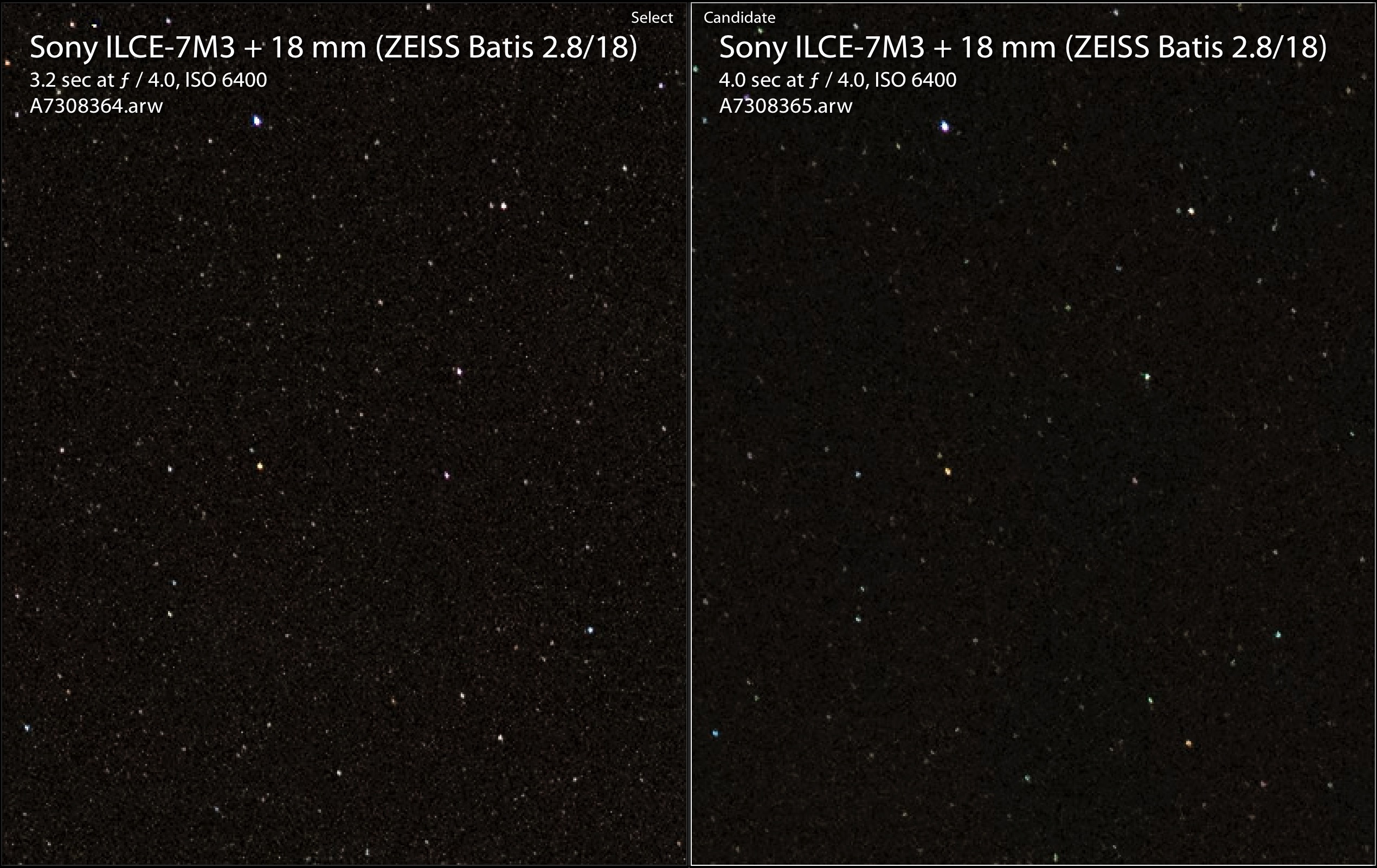
There’s definitely a difference in the 4 s exposure when compared to the 3.2 second exposure. At 4 seconds, noise is reduced dramatically and dim stars are further diminished in brightness, a clear indicator that Sony is filtering out the higher frequency noise and taking some stars with it. So star-eater is still present, but how does the problem compare with previous generations and how detrimental is it to actual shooting?
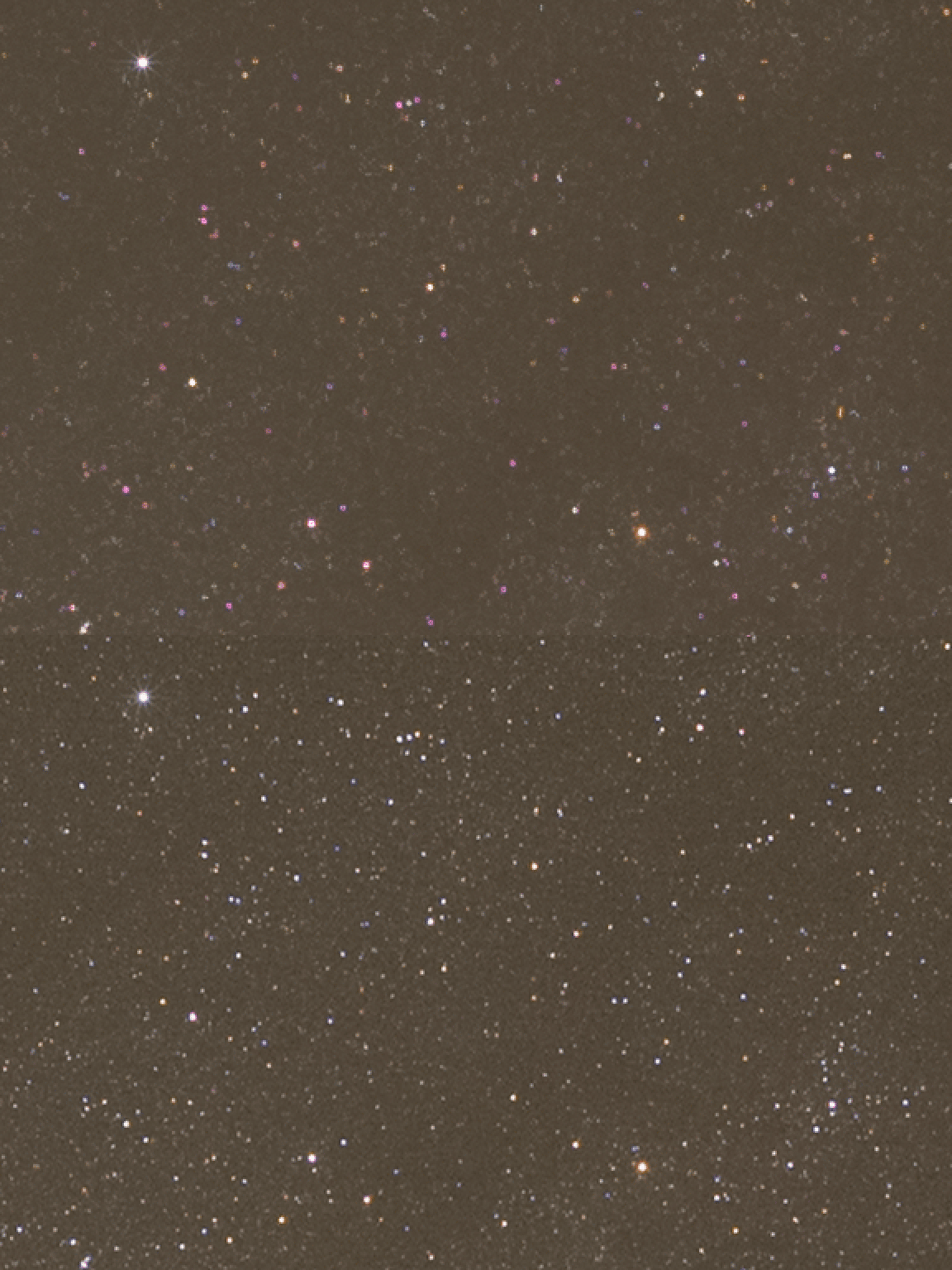
A 3.2 to 4 second exposure is a little short for most landscape astrophotos. Let’s take a look at a slightly more realistic 8 second exposure, compared with a previous generation camera that exhibits the star-eater issue (the a7S in Bulb-timed shooting mode). At 8 seconds long, on an 18mm lens, the stars should hopefully “burn-in” more and be less susceptible to the star-eater issue.
The comparison below shows an 8s star-eater exposure from the original generation a7S on the left (8s, Bulb-timed) versus a standard camera-timed 8s exposure from the a7III on the right. The a7S image was scaled to match for comparison purposes.
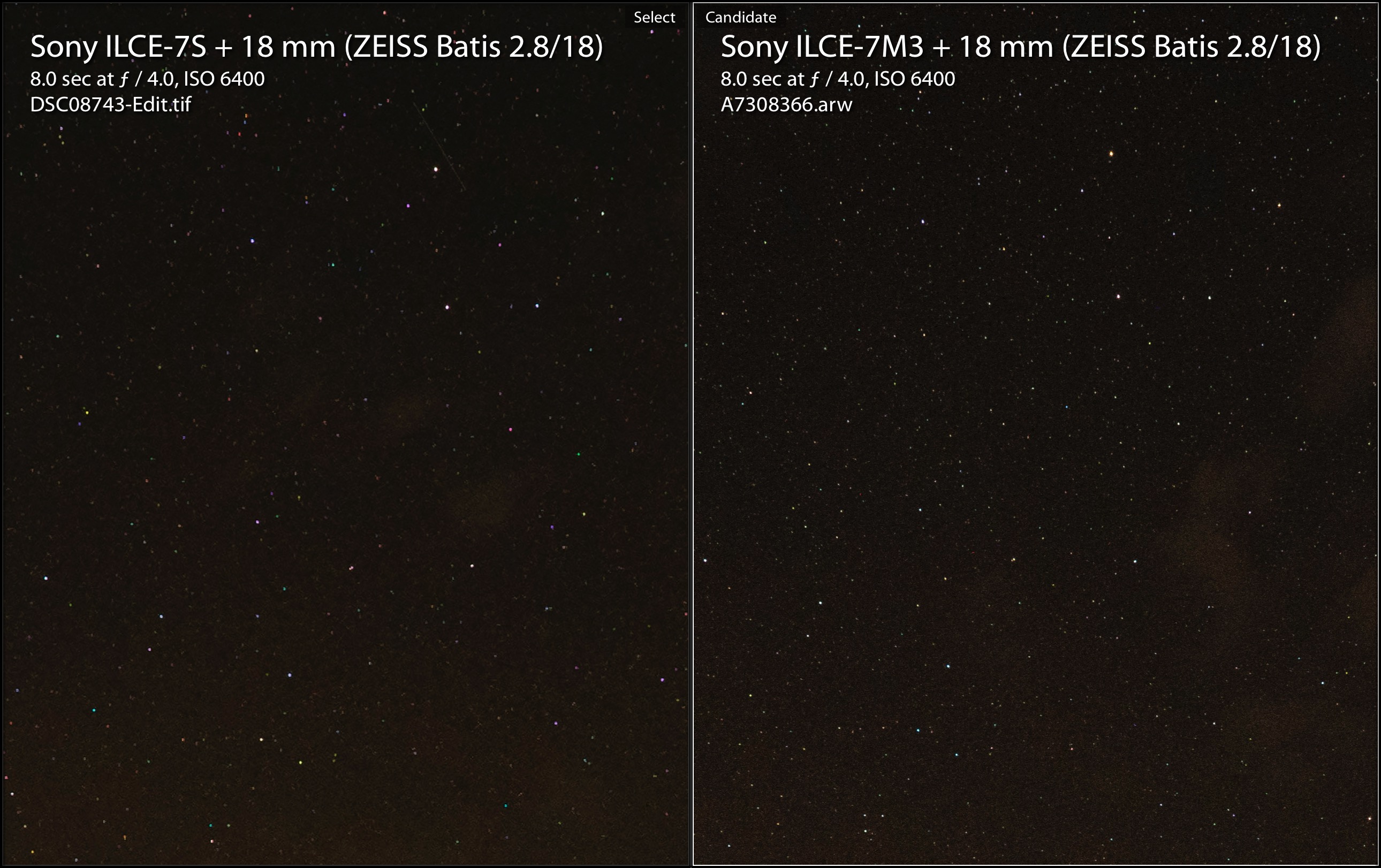
As you can see, the 8s a7III (right) shot looks a lot better than the star-eaten a7S Bulb shot (left). The a7S Bulb shot (left) shows some weird color shifted or blocky looking stars that appear a little bit defocused as a results of the old a7S’s spatial filtering (star-eater) in Bulb mode. The a7III shot shows more dim stars and stars appear markedly sharper than in the old a7S Bulb shot. Stars look “normal” in the a7III shot. This result is great news for astrophotographers looking to get the a7III.
If we compare details from that same 8s image from the a7III with an 8s non-star-eater (camera-timed) image from the a7S, differences become significantly less noticeable. The a7S image was scaled to match for comparison purposes.
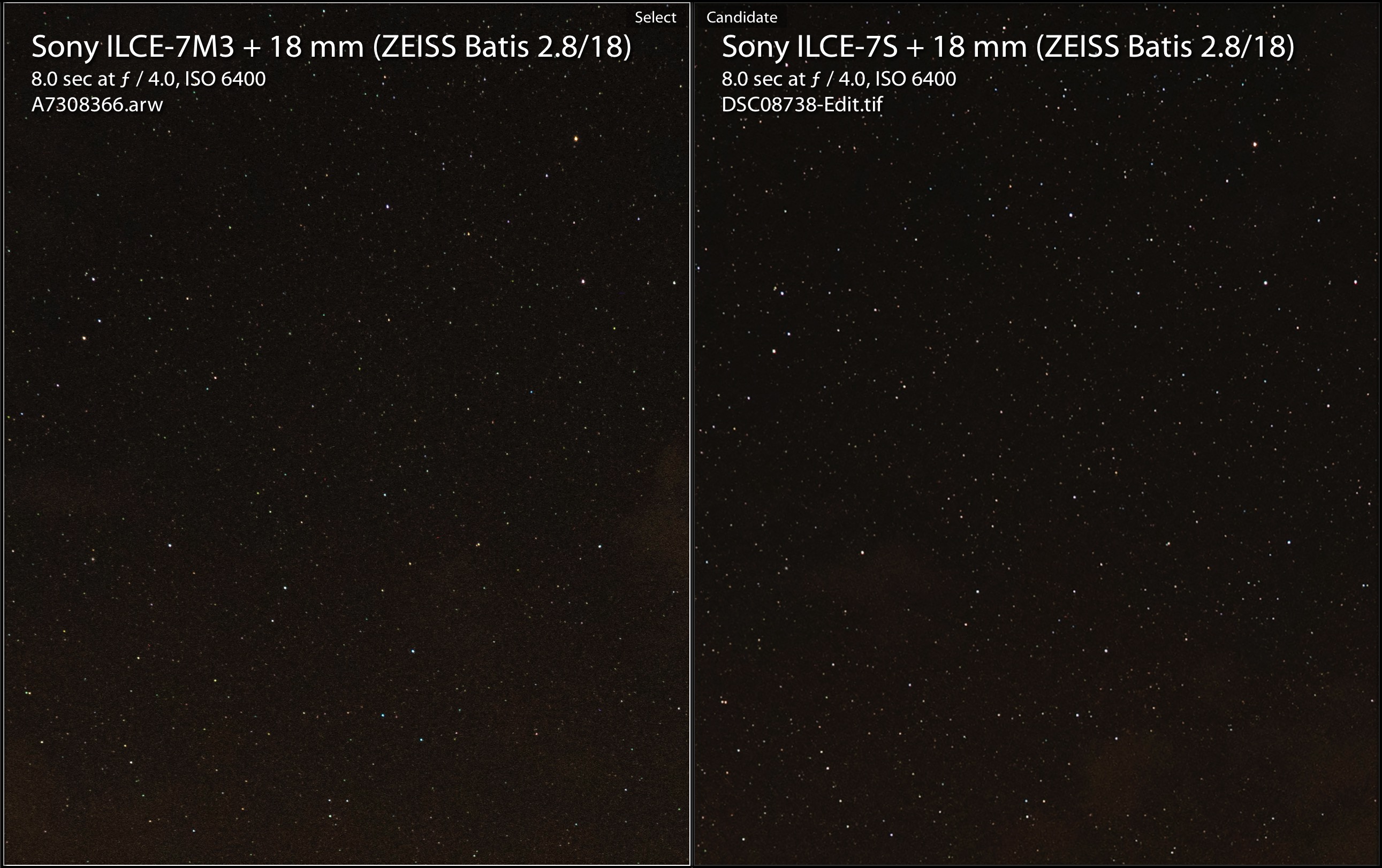
Here, both the a7III (left) and a7S (right) seem to be on par with each other in this direct 8S exposure comparison. The frequency and sharpness of stars look pretty much the same between both images. Upon very close inspection, I’d probably give the original a7S a very slight advantage in terms of noise but both cameras seem to do a good job at resolving fine stars.
So, there’s still some noise filtering in the Sony a7III, but in practice, it’s much improved from previous generations. Sony has obviously tweaked their noise algorithm a bit and the result is much more acceptable for typical night photography exposures. The a7III’s higher resolution sensor, when compared to the a7S probably also helps here. While star-eater is improved, it doesn’t hide the fact that the Sony is still doing some funky stuff to the a7III long exposure RAWs.
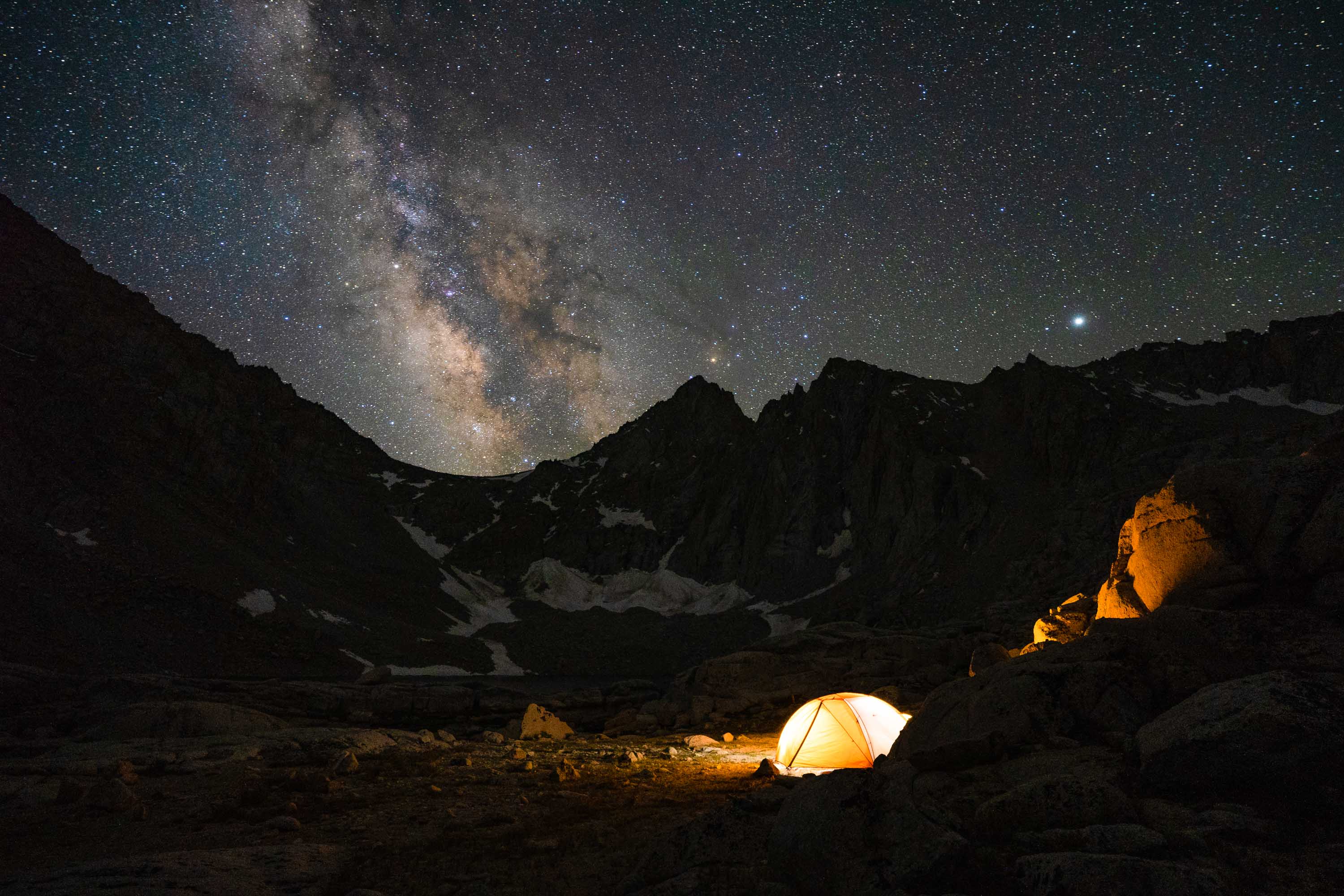
We wish that Sony did not apply a noise reduction algorithm as such to the a7III’s RAW files. RAW should be raw, unfiltered and un-baked. Ultimately, however, we really love most of the astrophotos that we’ve made from the a7III and we think that they speak for themselves.
References
For reference, here are a number of online sources that discuss the “Star Eater” problem:
DPReview:
https://www.dpreview.com/forums/post/58709160
https://www.dpreview.com/forums/post/55841466
Cloudy Nights:
https://www.cloudynights.com/topic/498339-sony-a7s-star-eater-algorithm/
https://www.cloudynights.com/topic/505754-another-real-world-example-of-sonys-star-eater-problem/
https://www.cloudynights.com/topic/558230-star-eater-in-action-sony-a7rii/
SAR:
http://www.sonyalpharumors.com/specific-a7sii-astrophotography-fix-request/#disqus_thread
Sony Community:
https://community.sony.com/t5/Alpha-NEX-Cameras/Star-eater-in-bulb-mode/td-p/508740
From Jim Kasson:
http://blog.kasson.com/the-last-word/spacial-filtering-of-raw-images-by-sony-a7s-a7ii/
http://blog.kasson.com/the-last-word/sony-a7rii-long-exposure-spatial-filtering-with-fw-3-30/
http://blog.kasson.com/the-last-word/16486/
http://blog.kasson.com/the-last-word/lenr-and-sony-a7rii-fw-3-30-lowpass-filteering/
http://blog.kasson.com/the-last-word/reverse-engineering-the-sony-a7rii-long-exposure-spatial-filtering/
http://blog.kasson.com/the-last-word/sony-a7rii-bulb-spatial-filtering/
Jim Kasson has written about a possible workaround on the a7RII by using “Continuous High or Continuous Low” modes.
hi, anyone with a6000 having thi problem?
Hi
I have a Sony a6000, however it looks like we only have the problem in bulb mode, awaiting response from Sony.
Davy
By the way my firmware version is 3.20
I have just gotten off the phone with a representative of Sony technical support line. Concerning the star eater problem with Sony cameras. Since I have the original models:Sony A7R and A7S, I asked if they were aware of this problem when using Bulb (B). She claimed that there is no problem at all with these models, “including bulb.” However, she said Sony was aware of and working on the known problem with A7RM2 and A7SM2. She documented my call and gave me a case number, even so.
I will have to re-read the technical data that Jim Kasson and others have posted, as I really thought my original Sony A7 models were good when choosing times from the menu, but would exhibit the problem if I used Bulb? After checking with her engineering dept., she was adamant that there was no problem, including Bulb on my models. I told her I would post her comments online for all to read.
If anyone out there has conflicting information about issues with the original A7R and S models, please post it here online. I can also be reached via my linked website above in the “Marty Knapp contact and about” area.
Hi Marty,
Thank you for this comment. As A7RII owner, I’m really happy to hear that this “issue” will be solved, at least we obviously have a good chance for that. ..4sec limit is unbearable with A7RM2 and A7SM2 at the moment (firmware v.3.30).
Ari
The Sony A7S was the camera on which the bulb mode star eater issue was first identified. My A7S is running firmware 3.10 and definitely has the problem in bulb mode. An update to firmware 3.20 is available but there is no way I’m installing it. I can’t take that risk because it is my dedicated astrophotography camera.
Mark (aka sharkmelley)
Called Sony (US) support today and added my two bodies to the list. (A7SM2 and A7RM2). Explained the problem to the support technician and interestingly enough she provided me with the category for the issue. “Are you interested in astrophotography?” yes. “We call that issue the star eater and we are aware of the problem and are working to have a solution.” I asked if I could revert the firmware and after checking with tier II support she said that I could not.
Another interesting point was that she said this was the first complaint that they had heard for the A7SM2.
She did close by saying that they are actively working the issue and that I should have a solution within 5 to 10 business days – which would be totally awesome. I am going to hold my breath and count… I hope they come through! Looks like your rant (and all the responses from others) is making a difference.
Cheers,
-bill
At the close of business today, it will have been 10 full business days since your posting (not counting the day you actually posted your comment). it is my hope that new firmware magically appears on their website, but I don’t think anyone is holding their breath. I am really hoping I’m wrong, but if the past is any indicator, we’ll have to buy new cameras or an app for this “enhancement”. Sony needed tremendous badgering to fix it’s compressed RAW issue from a couple years ago. I just don’t see that level of “encouragement” from Sony this time around. Until I hear otherwise, I’m sticking to Nikon for my long astro and the various a6xxx and a7s for anything nto involving BULB mode.
HI Ian
Have contacted Sony Support in the UK – +44 020 7365 2810, raised a firmware Fault request regarding Star Eater, Ref No – 15700487, I directed them to your article Lonleyspeck.com/stareater, they will escalete the problem and contact me within 24 – 48hrs, Hope this Helps.
Davy
Hi Ian
Do you have a number for the UK? and I will try contacting Sony at our part of the Globe, also have you thought of raising it on Social media as this avenue seems to get results when poeple complain.
Davy
I downloaded the sample images… Am I crazy or can I see more stars on the picture titled “sony-star-eater”? Is this a mistake or am I missing something?